Side Tipper Hire in South Africa, Gauteng — 10 Cube, 18 Cube, 34 Ton Single & Superlink
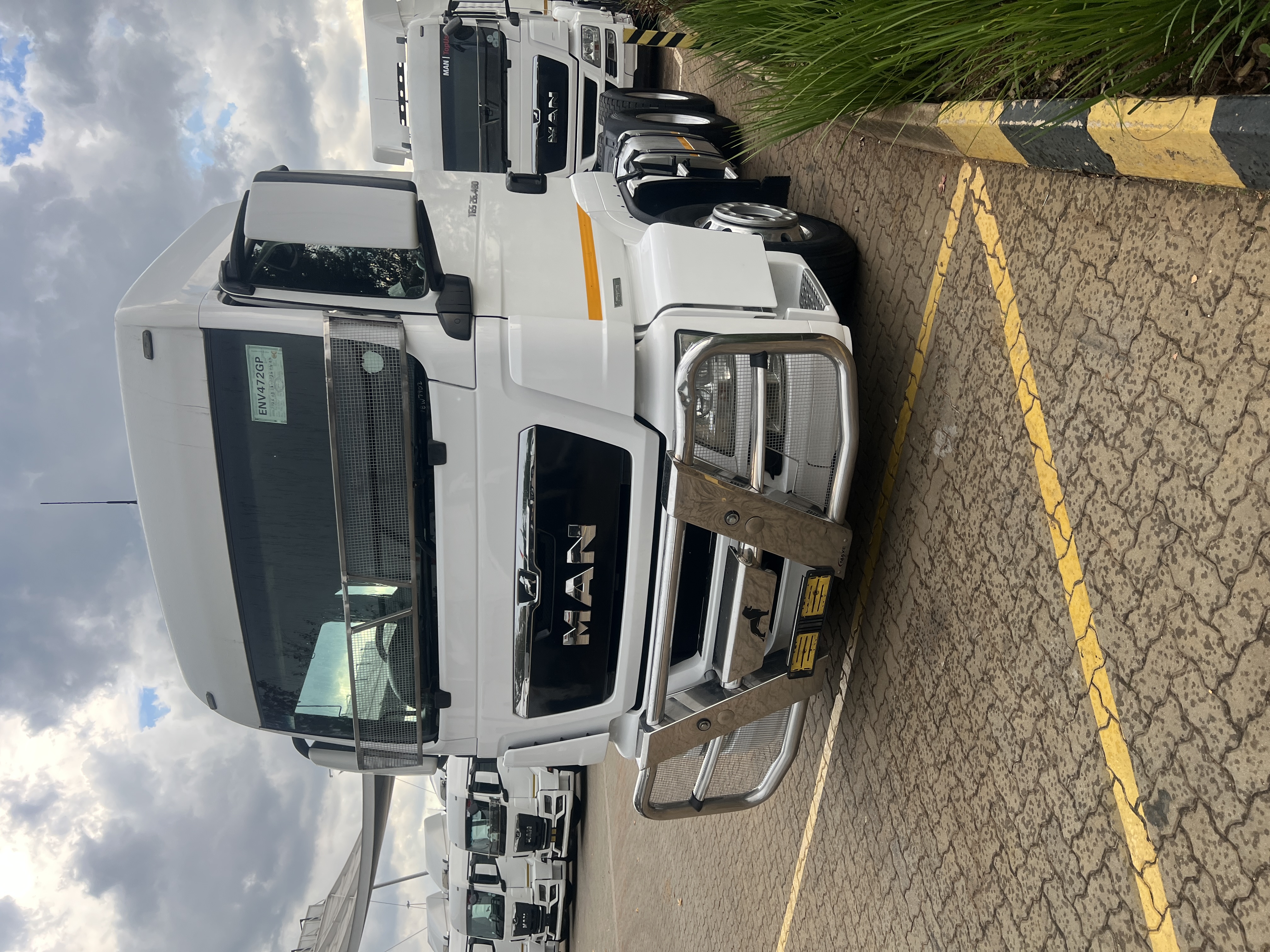
Verified transporter: side tipper hire in South Africa, Gauteng, MS Value Logistics. Available for daily, weekly, monthly, contract and cross-border bulk haulage.
Quick answer
A side tipper is a truck or trailer with a hydraulically operated bed that discharges its load to the left or right side rather than the rear. The tractor stays level throughout the tip — no reverse manoeuvre, no backward centre-of-gravity shift — which makes side tippers the safest and most versatile configuration for bulk commodity haulage. In South Africa, Gauteng you can hire a side tipper in every size: 10 cube, 18 cube, 34 ton single trailer, and 34 ton superlink (two trailers in series). They carry coal, chrome, manganese, iron ore, maize, wheat, sunflower, fertiliser, and aggregate. Prices start from R900.00 per day or R15.00 per km with a driver.
Why Side Tippers Dominate Southern African Bulk Haulage
Every tonne of coal that leaves Mpumalanga for Richards Bay, every tonne of chrome that leaves the Bushveld for Steelpoort, every tonne of maize that leaves the Free State for a mill, and every tonne of manganese that leaves the Northern Cape for Port Elizabeth or Saldanha — the vast majority of it moves on a side tipper. The reason is simple physics. A rear tipper has to reverse up to the discharge point, and as the bed rises backward, the centre of gravity shifts up and back. On level ground that is fine. On a mine bench, a quarry floor, a farm paddock, or any surface that is not perfectly flat, that rearward shift is a rollover risk — and rear tipper rollovers are a leading cause of serious injury and equipment damage in the bulk haulage industry.
A side tipper eliminates that risk. The tractor stays level. The load discharges to the left or right. The trailer does not rock backward because there is no rearward tip. And because the truck does not need to reverse into the discharge position, it can tip into places a rear tipper physically cannot reach — alongside a road, into a trench, into a hopper beside the load point, or onto a tip face where reversing access is restricted. That combination — safety on uneven ground, discharge without reversing, and faster cycle times on repeated loads — is exactly why side tippers dominate South African mining, agriculture, and bulk commodity logistics. If your material is loose, flowable, and measured in tonnes, a side tipper is almost certainly the correct configuration.
At a Glance — Side Tipper Specifications by Size
| Available sizes | 10 cube rigid · 18 cube rigid · 34 ton single trailer · 34 ton superlink (two trailers) |
|---|---|
| Bed volume range | 10 m³ (10 cube) to 36 m³ (superlink, both trailers) |
| Payload range | 15,000 kg to 34,000 kg |
| Discharge direction | Left or right side (selectable) |
| Discharge time | 30 – 60 seconds per trailer |
| Full cycle time | 4 – 8 minutes per load (with loader at pickup point) |
| Productivity | 6 – 12 loads per day on short-haul work · 1 – 2 long-haul trips per day |
| Tarp cover | Automatic or manual roll-over tarpaulin fitted as standard |
| Safety advantage | Tractor stays level — no rearward CG shift — safest tipper configuration on slopes |
| Loading method | Top loading by front-end loader, excavator, TLB, silo chute, or conveyor |
| Licence (10/18 cube) | Code 10 (C1) for 10 cube · Code EC + PrDP for 18 cube and above |
| Licence (34 ton) | Code EC + PrDP for both single trailer and superlink |
| Driver supplied | Yes — professional drivers experienced with bulk tipping operations |
| Service area | South Africa, Gauteng, MS Value Logistics, nationwide and Southern Africa cross-border |
Choose Your Side Tipper Size
Side tippers come in four main size classes, each suited to different haulage conditions and different commodity volumes. The right choice depends on the material density, the daily tonnage required, the loading equipment at the pickup point, and the distance to the discharge point. Here are the four side tipper sizes most requested in South Africa, Gauteng.
10 Cube Side Tipper Hire
10 m³ bedRigid chassisLocal haulageThe 10 cube side tipper is a rigid truck with a 10 m³ side-tipping bed. It is the entry-level side tipper and the standard configuration for local bulk deliveries — building sand and stone to construction sites, aggregate to concrete batching plants, topsoil and compost to landscaping projects, and rubble to registered landfills. Because it is rigid (not articulated), it can turn and tip in tighter spaces than a 34 ton rig, which makes it ideal for deliveries within city limits and on sites with restricted access. The 10 cube carries roughly 15 to 16 tonnes of dry sand, 13 to 14 tonnes of stone, or 8 to 9 tonnes of coal — always limited by weight, not volume, for dense materials.
Best for: building sand, plaster sand, river sand, stone, aggregate, crusher run, topsoil, compost, rubble, garden refuse, and any local bulk delivery where manoeuvrability matters.
Typical industries: building supply, hardware, landscaping, paving contractors, concrete batching, small-scale quarrying, and general earthworks.
Why customers choose it: the smallest true side tipper — ideal for daily local bulk deliveries. Cheaper to run than an articulated rig, easier to position at construction sites, and still gives you the side-discharge advantages over a rear tipper.
18 Cube Side Tipper Hire
18 m³ bedLarger rigidGrain & aggregateThe 18 cube side tipper carries roughly 18 m³ of loose material — 80% more volume than a 10 cube — on a heavier-rated rigid chassis. It is the standard configuration for grain deliveries from silos to mills, fertiliser distribution from ports to inland depots, and aggregate deliveries where larger volumes are needed but an articulated rig would be over-capitalised. The 18 m³ bed is large enough to carry a full grain load without over-weighting the truck, and the side-discharge mechanism lets it tip directly into a bunker, hopper, or alongside a store at the delivery point.
Best for: maize, wheat, sunflower, sorghum, fertiliser, cement clinker, aggregate, sand, stone, and any bulk commodity where the volume justifies a larger rigid tipper.
Typical industries: agriculture and grain handling, fertiliser distribution, quarrying, cement and clinker, and regional aggregate supply.
Why customers choose it: the largest side tipper available on a rigid chassis. It handles commercial grain and fertiliser volumes that a 10 cube cannot, while remaining manoeuvrable enough for regional deliveries and farm access.
34 Ton Single Side Tipper Hire
34 tonnesSingle trailerRegional haulageThe 34 ton single side tipper is an articulated rig — truck-tractor with a single side-tipping semi-trailer — carrying up to 34,000 kg of payload across a 12 to 13.5 m trailer. It is the standard configuration for regional bulk haulage where a single-trailer load is appropriate: deliveries to smaller mines and quarries, regional grain and fertiliser runs, and mid-distance aggregate delivery. The single trailer gives better manoeuvrability than a superlink in restricted yards and mine pits, while still delivering the full 34 tonne payload on a single trip.
Best for: coal, chrome, manganese, iron ore, maize, wheat, fertiliser, aggregate, and any bulk commodity where the load justifies a 34 tonne single-trailer run.
Typical industries: mining, quarrying, agriculture and grain handling, fertiliser distribution, cement and clinker, and bulk commodity traders.
Why customers choose it: the middle ground between a rigid 18 cube and a full superlink. Handles the same payload as a superlink per trailer, but is more manoeuvrable at tight delivery points and mine pits with restricted access.
34 Ton Superlink Side Tipper Hire
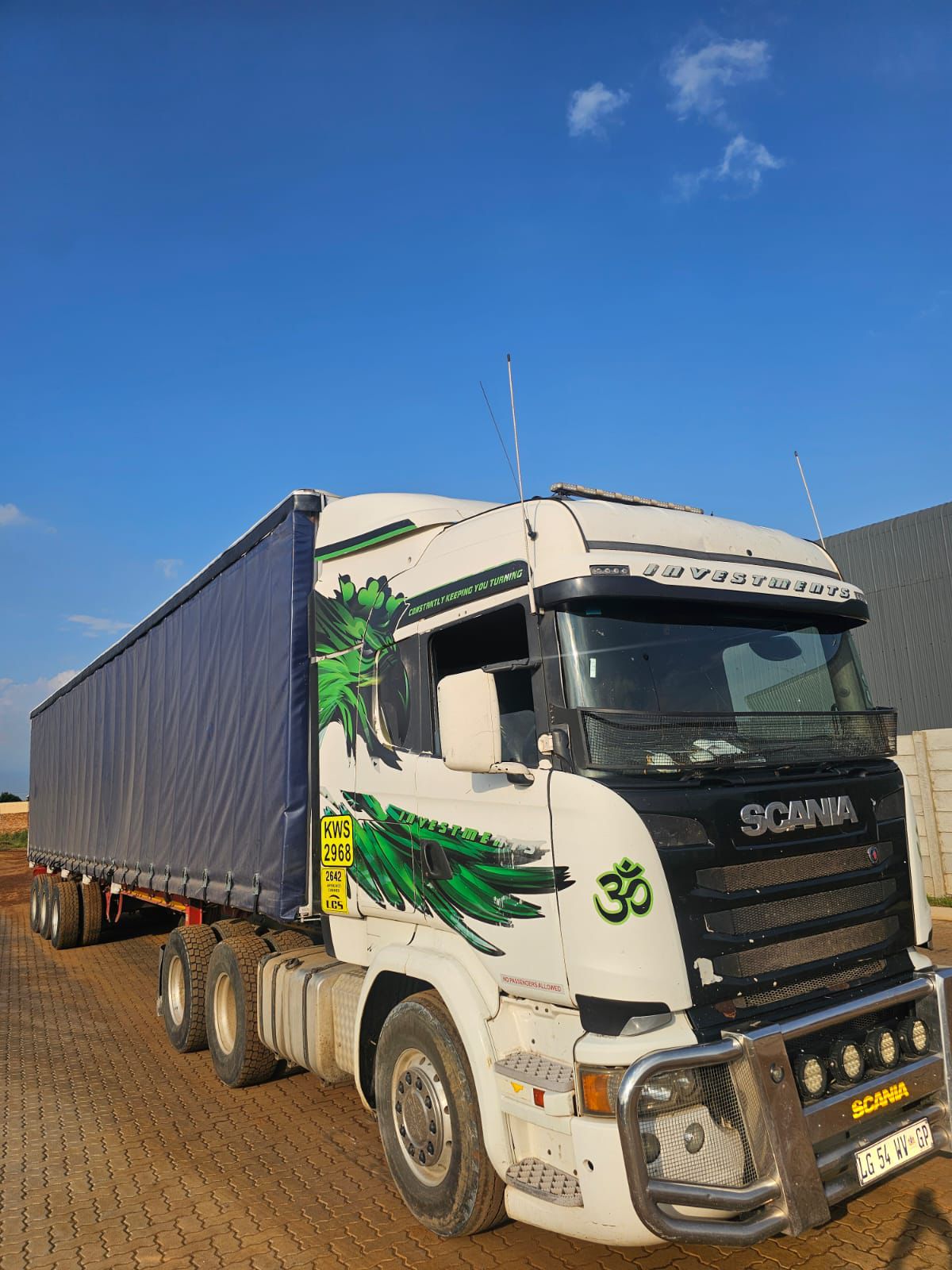
Two trailers34 tonnes totalBulk commodity standardThe 34 ton superlink side tipper is the heavyweight of Southern African bulk haulage. It consists of a truck-tractor towing two side-tipping trailers in series — usually an 11 to 13.5 m lead trailer and an 8 to 10 m pup trailer, connected by a converter dolly. Total payload is up to 34,000 kg across the two trailers, and total bed volume reaches 30 to 36 m³. Both trailers discharge sideways, letting the combination tip without reversing. The superlink side tipper is the standard workhorse for the coal corridor (Mpumalanga to Richards Bay), the grain corridors (Free State and North West to mills and ports), the chrome and manganese corridors (Bushveld and Northern Cape to ports), and cross-border bulk haulage into Botswana, Zimbabwe, Zambia, and Mozambique.
Best for: coal, chrome, manganese, iron ore, platinum concentrates, maize, wheat, sunflower, sorghum, fertiliser, cement clinker, aggregate, and any high-volume bulk commodity that justifies the full 34 tonne superlink load.
Typical industries: coal mining, chrome and manganese mining, iron ore export, platinum group metals, agriculture and grain handling, fertiliser production and distribution, cement, and quarrying.
Why customers choose it: one tractor and one driver do the work of two single-trailer runs. Fuel cost per tonne-kilometre drops significantly, and the two-trailer format maximises legal payload per trip on South Africa's 56,000 kg GCM limit. The superlink is the standard configuration for bulk commodity contracts on every major corridor.
Side Tipper vs Back Tipper vs Bottom Dumper — Side by Side
| Feature | Side Tipper | Back Tipper | Bottom Dumper |
|---|---|---|---|
| Discharge direction | Left or right (selectable) | Rear (bed rises backwards) | Beneath (bed opens at base) |
| Positioning to discharge | Truck stays parallel to discharge point — no reversing | Must reverse into discharge position | Drives over a hopper or trench |
| Safety on slopes | Safer — tractor stays level, no CG shift | Risk of rollover — CG shifts back and up | Safer — no bed rise |
| Discharge into confined spaces | Excellent — can tip into trenches, alongside roads | Restricted — needs reversing access | Restricted — needs trench or hopper |
| Best material | Coal, grain, chrome, ore, aggregate | Sand, stone, rubble, soil, gravel | Coal, ore, aggregate (high-volume) |
| Best industry | Mining, agriculture, bulk commodity | Construction, rubble removal, building supply | Large-scale mining and quarrying |
| Common sizes | 10 cube, 18 cube, 34 ton single, 34 ton superlink | 4–5 ton, 8–10 ton, 10 cube, 18 cube, 34 ton | 34 ton superlink |
| Availability | Common in 10 cube and larger | Very common across all sizes | Specialist — quoted per project |
Not sure which tipper configuration suits your material and discharge point? Send us a description on WhatsApp and we will recommend the correct setup — free of charge.
What Can a Side Tipper Carry? Load Guide by Material
Side tipper payload is limited by weight for dense materials and by volume for light materials. This is the single most important thing to understand when booking a side tipper. Here are approximate payloads for common commodities on the standard side tipper sizes:
| Material | Density | 10 cube | 18 cube | 34 ton superlink |
|---|---|---|---|---|
| Coal | ~0.85 t/m³ | ~8.5 t | ~15 t | ~34 t |
| Chrome ore | ~2.5 t/m³ | ~15 t (weight-limited) | ~25 t (weight-limited) | ~34 t (weight-limited) |
| Manganese ore | ~2.2 t/m³ | ~15 t (weight-limited) | ~25 t (weight-limited) | ~34 t (weight-limited) |
| Iron ore | ~2.5 t/m³ | ~15 t (weight-limited) | ~25 t (weight-limited) | ~34 t (weight-limited) |
| Maize | ~0.75 t/m³ | ~7.5 t | ~13.5 t | ~34 t (volume-limited at ~45 m³) |
| Wheat | ~0.78 t/m³ | ~7.8 t | ~14 t | ~34 t |
| Sunflower seed | ~0.4 t/m³ | ~4 t | ~7 t | ~14 t (volume-limited) |
| Fertiliser (bulk) | ~1.1 t/m³ | ~11 t | ~20 t | ~34 t |
| Aggregate / stone | ~1.5 t/m³ | ~15 t | ~25 t | ~34 t |
| Sand (dry) | ~1.6 t/m³ | ~16 t (weight-limited) | ~25 t (weight-limited) | ~34 t (weight-limited) |
| Cement clinker | ~1.4 t/m³ | ~14 t | ~25 t | ~34 t |
| Wood chips | ~0.3 t/m³ | ~3 t (volume-limited) | ~5.5 t (volume-limited) | ~11 t (volume-limited) |
Dense materials (chrome, manganese, iron ore, sand) hit the weight limit before filling the bed. Light materials (sunflower seed, wood chips) fill the bed before reaching the weight limit. Tell us your material type at quote stage so we confirm which limit applies and allocate the correct side tipper size for your job. Overloading a side tipper is dangerous and illegal — always confirm the correct tonnage for your material.
Side Tipper Hire Prices in South Africa, Gauteng
Side tipper hire pricing depends on the size class, the commodity, the loading equipment available at the pickup point, the discharge conditions, and whether the trip is local, long-distance, or cross-border. The two standard options below cover the vast majority of bookings.
Option 1 — Truck + Side Tipper
Self-drive, no driver
R 900.00 / Day
R 15.00 / km
Licence varies by size — see specifications above. Fuel, tolls and driver excluded.
Enquire NowOption 2 — Truck + Driver
Full day with professional driver Best value
R 1,050.00 / Day
R 16.50 / km
Driver, insurance and goods-in-transit cover included. Weighbridge compliance advisory on bulk loads.
Chat on WhatsAppWhat Affects the Cost of Side Tipper Hire?
- Side tipper size: the biggest single factor. A 10 cube side tipper costs a fraction of a 34 ton superlink, and pricing scales with payload, bed volume, and the number of trailers.
- Commodity type: dense materials (chrome, manganese, iron ore) require more trips per tonne than light materials (coal, maize) because of the weight limit — this affects total cost per delivered tonne.
- Distance: the per-kilometre rate drives your final price. Short-haul bulk deliveries within South Africa, Gauteng are charged differently to long-distance commodity corridor runs and cross-border trips.
- Loading equipment: a front-end loader, excavator, or overhead silo at the pickup point is the client's responsibility. We do not supply loading equipment unless quoted separately.
- Discharge conditions: standard discharge (tipping into a designated tip face or bunker) is included. Off-road discharge on a mine bench, quarry floor, or farm paddock is quoted per job and may require a heavier-spec side tipper.
- Driver requirement: adding a professional driver adds a fixed daily fee but ensures safe tipping practice and current weighbridge compliance. For 34 ton superlinks, a Code EC licence and PrDP are essential.
- Tarpaulin type: automatic roll-over tarps are standard. Internal liners for grain (to keep moisture out and allow complete cleanout) are quoted separately if required.
- Weighbridge fees: weighbridge certification at pickup and delivery is quoted as a disbursement. Weighbridge certificates are provided on request for compliance documentation.
- Tolls, permits, and cross-border documentation: quoted separately for long-distance and cross-border trips.
- Duration and contract: weekly, monthly and long-term contracts attract significant discounts over daily rates. Bulk commodity contracts are typically quoted on a per-tonne or per-trip basis.
Industries We Serve with Side Tippers in South Africa, Gauteng
- Coal mining: Mpumalanga collieries to Richards Bay Coal Terminal, Witbank power stations, and export terminals on 34 ton superlink side tippers.
- Chrome mining: Bushveld chrome mines to Steelpoort smelters, Rustenburg, and Durban export terminals.
- Manganese mining: Northern Cape and North West manganese mines to Port Elizabeth, Saldanha, and Durban for export.
- Iron ore: Northern Cape iron ore to Saldanha port and inland steel mills.
- Platinum group metals: PGM concentrate haulage from Rustenburg and Northam to smelters and refineries.
- Grain farming and co-ops: maize, wheat, sunflower, and sorghum from Free State, North West, and Mpumalanga silos to mills, feedlots, and export terminals.
- Fertiliser distribution: bulk fertiliser from Richards Bay and Durban port terminals to inland agricultural depots and farms.
- Cement and clinker: cement clinker from kilns to grinding plants, and bulk cement to batching facilities.
- Quarrying and aggregate: aggregate, crusher run, and stone from quarries to concrete plants and construction sites.
- Cross-border bulk: coal, chrome, manganese, grain, and fertiliser into Botswana, Zimbabwe, Zambia, and Mozambique.
Long-Distance Side Tipper Corridors
We arrange long-distance side tipper haulage on South Africa's main bulk commodity corridors, with experienced drivers and full documentation support. Common routes from South Africa, Gauteng include:
- Coal corridor: Mpumalanga collieries (Witbank, Middelburg, Ermelo) to Richards Bay Coal Terminal via the N2 and N4 — the single largest side tipper corridor in South Africa.
- Grain corridors: Free State and North West silos to Gauteng mills via the N1, N3, and N12; coastal grain terminals via the N1 to Cape Town and the N3 to Durban.
- Chrome and manganese corridors: North West and Limpopo Bushveld to Steelpoort and Rustenburg; Northern Cape manganese to Port Elizabeth, Saldanha, and Durban.
- Iron ore corridor: Northern Cape iron ore to Saldanha via the N7 and N14.
- Fertiliser corridor: Richards Bay and Durban fertiliser terminals to inland agricultural depots via the N2 and N3.
- Aggregate corridor: Gauteng and Mpumalanga quarries to construction sites along the N1, N3, N4, and N12.
- Cross-border bulk corridors: coal and chrome into Botswana and Zimbabwe via Skilpadshek and Beitbridge; grain and fertiliser into Zambia and Zimbabwe via Beitbridge and Kazungula.
Long-distance bulk contracts typically require 48 to 72 hours' advance notice for permit confirmation, weighbridge documentation, and driver scheduling. Contract haulage on a per-tonne basis is available for high-volume repeat work. Contact us on WhatsApp on +27 62 345 2345 for a corridor-specific bulk haulage quote.
How to Book a Side Tipper in South Africa, Gauteng
- Tell us your material and tonnage. Enter your commodity type, approximate tonnage or volume, pickup point, and discharge point in the free estimate form on this page.
- Get an instant distance and fare. Our system calculates the road distance and your estimated fare immediately — no waiting for a callback.
- Choose your side tipper size. 10 cube, 18 cube, 34 ton single, or 34 ton superlink; self-drive or with driver.
- Confirm your booking. Submit the form or message us on WhatsApp. You will receive written confirmation with the trailer details, driver details, weighbridge plan, and final price.
- Loading and discharge. Confirm loading equipment at the pickup point. Confirm discharge conditions (on-road or off-road). We provide the correct side tipper for your material and discharge arrangement.
- Long-distance or cross-border contracts: we will confirm permits, weighbridge documentation, and any cross-border requirements before departure.
Why Choose WeTransport for Side Tipper Hire
Verified & Fully Insured
Every side tipper is licensed, roadworthy, and covered by comprehensive insurance plus goods-in-transit cover for bulk commodity loads.
Weighbridge Compliance Advisory
We confirm the correct tonnage for your material density and axle-loading limits. Weighbridge certificates available on request.
Single Trailer & Superlink Configurations
34 ton single trailer for restricted access, superlink for maximum legal payload — both configurations available on every corridor.
Bulk Haulage Experienced Drivers
Code EC drivers with PrDP who are experienced on mine benches, quarry floors, farm paddocks, and off-road discharge conditions.
Transparent Pricing
Clear per-day, per-kilometre, and per-tonne rates quoted up front. No hidden call-out fees or surprise surcharges on bulk contracts.
Side Tipper Hire in MS Value Logistics and Nearby Areas
We arrange side tipper hire throughout South Africa, Gauteng and the greater MS Value Logistics region, including local bulk deliveries, regional commodity haulage, long-distance corridor runs, and cross-border bulk contracts. Popular side tipper routes from South Africa, Gauteng include runs to Richards Bay, Witbank, Steelpoort, Rustenburg, Saldanha, Port Elizabeth, Durban, Cape Town, Bloemfontein, Polokwane, Nelspruit, and cross-border to Gaborone, Windhoek, Harare, Lusaka, and Maputo.
Insurance, Tracking & Compliance
- Insurance: Yes Active
- Live tracking: Live GPS tracking available
- Goods in transit: Yes Active
- Driver compliance: valid licence for the side tipper class (Code 10 or Code EC), valid PrDP where required, and medical fitness certificate
- Vehicle compliance: current licence disc, roadworthy certificate, operator card, calibrated tachograph where required, and current hydraulic and tipping-gear inspection certificate
- Overload compliance: loads verified against axle, GCM, and trailer plate limits before departure. Weighbridge certificates available on request for compliance documentation.
- Tarpaulin compliance: tarpaulin covers fitted and tensioned for every load, complying with road transport regulations on loose material
- Cross-border compliance: COMESA Yellow Card, bilateral permits, TIP, transit bond, and country-specific GIT confirmation arranged per corridor