Tipper Truck Hire in South Africa, North West — Back Tipper, Side Tipper, 10 & 18 Cube & 34 Ton

Verified transporter: tipper truck hire in South Africa, North West, Dr Mpho Ramarumo. Available for hourly, daily, weekly, monthly, long-distance and off-road haulage.
Quick answer
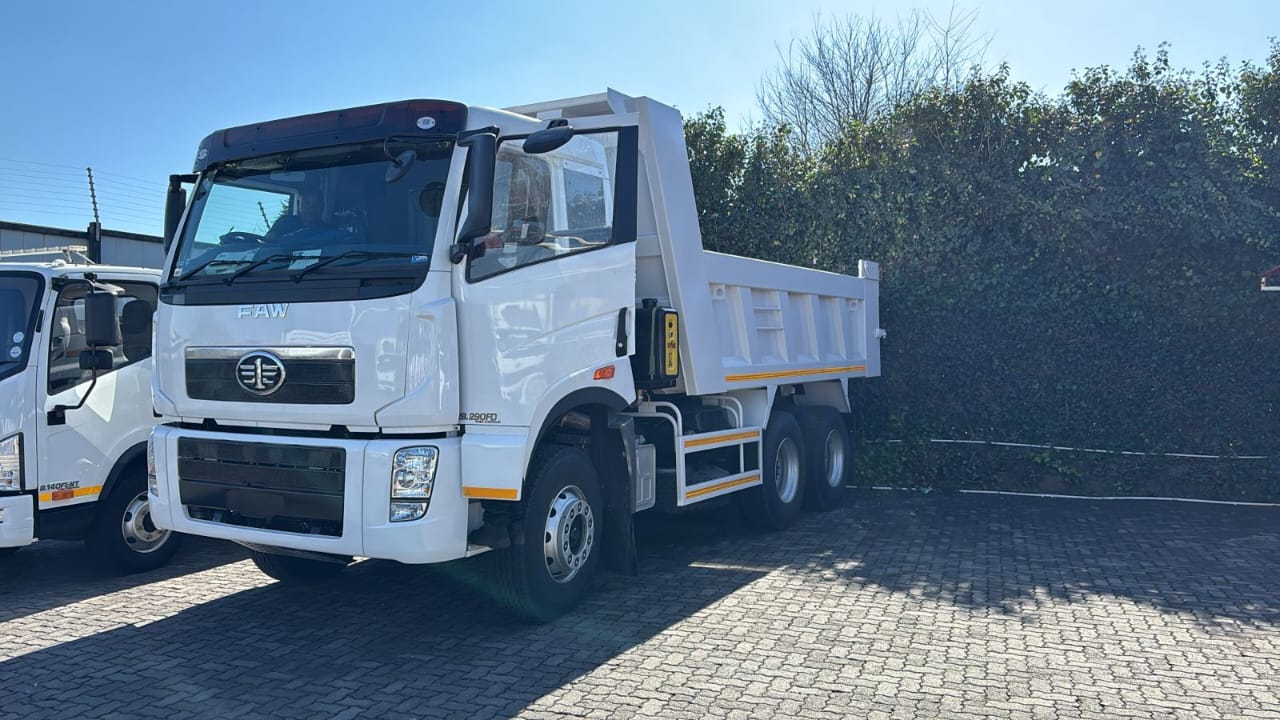
A tipper truck (also called a dumper or dump truck) has a hydraulically operated tipping bed for discharging loose bulk materials — sand, stone, gravel, rubble, soil, coal, grain and aggregate. In South Africa, North West you can hire a tipper in every configuration: back tipper (rear discharge for construction), side tipper (side discharge for mining and agriculture), 10 cube and 18 cube rigids, and the 34 ton superlink side tipper for bulk commodity haulage. Prices start from R900.00 per day or R15.00 per km with a driver.
Why the Tipper Truck Is the Backbone of Bulk Haulage in South Africa
The tipper is the original bulk-haulage workhorse. Whether you are moving building sand across a construction site, hauling coal from a mine bench, delivering aggregate to a concrete batching plant, or clearing demolition rubble from a residential site, the tipper is almost always the vehicle that gets the job done. The reason is simple: the hydraulic tipping mechanism. A load that would take a flatbed crew thirty minutes to unload by hand tips out in under two minutes with zero manual labour — a productivity advantage that makes the tipper the standard configuration for every industry that deals in bulk materials.
South Africa runs on tippers. Coal moves from Mpumalanga mines to Richards Bay on 34 ton superlinks. Maize moves from Free State silos to mills on side tippers. Building sand moves from quarries to building sites on 10 cube back tippers. Rubble moves from demolition sites to landfills on 4–5 ton rigids. That is the tipper economy — and it is why tipper truck hire is one of the highest-volume vehicle categories in the country, spanning every size class from a small 3-tonne rigid to a 34-tonne articulated superlink.
At a Glance — Tipper Truck Specifications by Size
| Available sizes | 4–5 ton rigid · 8–10 ton rigid · 10 cube · 18 cube · 34 ton single · 34 ton superlink |
|---|---|
| Tipping configurations | Back tipper (rear discharge) · Side tipper (side discharge) · Bottom dumper |
| Bed volume range | 3 m³ (4–5 ton) to 18+ m³ (18 cube) per trailer · up to 36 m³ on a superlink |
| Payload range | 3,000 kg to 34,000 kg |
| Tipping cycle | 30 – 90 seconds per discharge · 3 – 6 minutes per full load cycle |
| Productivity | 8 – 12 loads per day on a well-run site · higher on short haul |
| Materials carried | Sand · stone · gravel · aggregate · rubble · soil · coal · chrome · manganese · maize · wheat · fertiliser · wood chips |
| Tipping surface | On-road (hardstand) · off-road (quarry floor, farm, mine bench) — off-road tipper available on request |
| Licence (light tipper) | Code 10 (C1) for 4–5 ton |
| Licence (heavy tipper) | Code EC + PrDP for 8–10 ton and 34 ton superlink |
| Driver supplied | Yes — professional drivers experienced with tipping operations |
| Service area | South Africa, North West, Dr Mpho Ramarumo, nationwide and Southern Africa cross-border |
Choose Your Tipper Configuration
Tippers come in several configurations, each suited to different tipping conditions and different materials. The right choice depends on where the load must discharge — a hardstand hopper, an open tip face, a trench, a quarry bench, or a farm paddock. Here are the most requested tipper configurations in South Africa, North West.
Back Tipper Truck Hire (Rear Discharge)
Rear dischargeConstruction standardReverse to tipThe back tipper — also called a rear tipper or rear-discharge dumper — tips backwards. The bed rises at the front and the load discharges off the rear. It is the classic tipper configuration, and the standard for construction sites, rubble removal, and general building material delivery. Back tippers work best when the driver can reverse up to a drop point: a hopper, a tip face, a building site, a landfill bay, or a trench edge. The rear-discharge design also allows more precise placement of the load — the driver can reverse, tip, and pull forward, leaving the material exactly where the site foreman wants it.
Best for: building sand, plaster sand, river sand, stone, gravel, aggregate, crusher run, topsoil, compost, rubble and demolition debris, garden refuse, mixed site waste.
Typical industries: construction, civil engineering, building supply, rubble removal, landscaping, and general site clearance.
Why customers choose it: the most common tipper configuration in South Africa — an everyday workhorse for building sites and rubble removal. Easy to reverse into position, precise load placement, and the widest availability across all sizes.
Side Tipper Truck Hire (Side Discharge)
Side dischargeMining & agricultureSafe on slopesThe side tipper tips sideways — the bed rolls to the left or right and the load discharges to the side. Side tippers are essential when the truck cannot reverse into position: tipping into a trench, alongside a road, into a hopper beside the load point, or onto the tip face of a mine bench. They are also safer on sloped or unstable ground because the tractor stays level while the trailer discharges — the centre of gravity does not shift backwards as it does on a rear tipper. That safety advantage is one reason side tippers dominate South African bulk mining and agriculture.
Best for: coal, chrome, manganese, iron ore, maize, wheat, sunflower, sorghum, fertiliser, cement clinker, sand, stone, aggregate, and any bulk commodity that needs to discharge sideways.
Typical industries: coal mining, chrome and manganese mining, iron ore, grain farming, agricultural cooperatives, fertiliser distribution, cement production, and quarrying.
Why customers choose it: side tipping is safer on unstable ground, faster in confined tip positions, and the only configuration that works when the truck cannot reverse to the discharge point. Superlink side tippers are the standard haulage configuration for coal, grain, and other bulk commodities across South Africa.
10 Cube Tipper Truck Hire
10 m³ bedRigid chassisConstruction & sandThe 10 cube tipper is a rigid truck with a tipping bed of approximately 10 cubic metres. Because it is rigid (not articulated), it can turn and tip in tighter spaces than a 34 ton rig, which makes it the standard configuration for building sites, sand and stone deliveries within city limits, and rubble removal in residential areas. It carries roughly 15–16 tonnes of sand, or 12–14 tonnes of stone — always limited by weight, not volume — and comfortably tips directly into a building site hopper or onto a driveway.
Best for: building sand, plaster sand, river sand, stone, gravel, aggregate, rubble, topsoil, compost, garden refuse, and any short-haul bulk delivery where manoeuvrability matters.
Typical industries: building supply, hardware, construction, plumbing and paving contractors, landscaping, and general delivery.
Why customers choose it: the ideal size for city deliveries. Easier to manoeuvre than a 34 ton rig, cheaper to run, and still carries a full 10 m³ load in one trip. Most building suppliers and sand merchants run 10 cube tippers as their standard delivery vehicle.
18 Cube Tipper Truck Hire
18 m³ bedLarger rigidVolume loadsThe 18 cube tipper carries approximately 18 cubic metres — 80% more volume than a 10 cube, but on a similar rigid chassis with heavier-rated axles. It is the go-to configuration for volume-critical loads: bulky but relatively light materials such as topsoil, compost, wood chips, sawdust, dry rubble, and light aggregate. Because the 18 m³ bed is much larger than the 10 m³, you can carry more volume of light materials per trip before hitting the weight limit — critical for contractors who need to move big volumes of relatively low-density material in the fewest possible trips.
Best for: topsoil, compost, mulch, wood chips, sawdust, dry rubble, garden refuse, light aggregate, and any bulky, low-density material where volume (not weight) is the limiting factor.
Typical industries: landscaping, gardening, agriculture, forestry, mulch and compost supply, and general earthworks.
Why customers choose it: the biggest bed available on a rigid chassis. Where a 10 cube would fill up before it hit its weight limit, an 18 cube lets you carry the full volume of a light material in one trip.
34 Ton Side Tipper Superlink Hire
Superlink34 tonnes payloadBulk commodity standardThe 34 ton superlink side tipper is the heavyweight of South African bulk haulage. It consists of a truck-tractor towing two side-tipping trailers in series — usually a lead trailer and a pup trailer, connected by a converter dolly — with a combined capacity of up to 34,000 kg and up to 36 m³ of volume. It is the standard configuration for coal haulage from Mpumalanga mines to Richards Bay, for maize from Free State silos to mills, for chrome and manganese from the North West to ports, and for aggregate from quarries to concrete plants. The side-tipping action lets the entire combination discharge without reversing, and the two-trailer format maximises payload per trip.
Best for: coal, chrome, manganese, iron ore, platinum concentrate, maize, wheat, sunflower, sorghum, fertiliser, cement clinker, aggregate, and any high-volume bulk commodity that justifies a full 34 tonne load.
Typical industries: coal mining, chrome and manganese mining, iron ore, platinum, gold, grain farming, agricultural cooperatives, fertiliser production, cement, and quarrying.
Why customers choose it: maximum payload per trip — one tractor and one driver do the work of two single-trailer runs. Fuel cost per tonne-kilometre drops significantly. The superlink side tipper is the standard workhorse for bulk commodity haulage on South African long-distance corridors.
Back Tipper vs Side Tipper vs Bottom Dumper — Side by Side
| Feature | Back Tipper | Side Tipper | Bottom Dumper |
|---|---|---|---|
| Discharge direction | Rear (bed rises at front) | Side (bed rolls left or right) | Beneath (bed opens at base) |
| Positioning | Must reverse to the drop point | Truck stays parallel to drop point | Drives over a hopper or trench |
| Safety on slopes | Risk of rollover — CG shifts back | Safer — tractor stays level | Safer — no bed rise |
| Best material | Sand, stone, rubble, soil, gravel | Coal, grain, aggregate, chrome, ore | Coal, ore, aggregate (high-volume) |
| Best industry | Construction, rubble removal, building supply | Mining, agriculture, cement, fertiliser | Large-scale mining and quarrying |
| Common sizes | 4–5 ton, 8–10 ton, 10 cube, 18 cube, 34 ton | 10 cube, 18 cube, 34 ton superlink | 34 ton superlink |
| Availability | Very common across all sizes | Common in 10 cube and 34 ton classes | Specialist — quoted per project |
Not sure which tipper configuration suits your site or material? Send us a description on WhatsApp and we will recommend the correct setup — free of charge.
What Can a Tipper Truck Carry? Real-World Load Guide by Material
Tipper payload is limited by weight, not volume, for dense materials — and by volume, not weight, for light materials. This is the most important thing to understand when booking a tipper. Here are approximate tonnages for common materials on a typical tipper chassis:
| Material | Approximate density | 10 m³ carries | 18 m³ carries |
|---|---|---|---|
| Dry sand | ~1.6 t/m³ | ~16 tonnes (weight-limited) | ~16 tonnes (weight-limited) |
| Wet sand | ~1.9 t/m³ | ~15 tonnes | ~15 tonnes |
| Stone / aggregate | ~1.5 t/m³ | ~14 tonnes | ~14 tonnes |
| Building rubble | ~1.3 t/m³ | ~13 tonnes | ~13 tonnes |
| Topsoil | ~1.3 t/m³ | ~13 tonnes | ~13 tonnes |
| Compost | ~0.6 t/m³ | 6 m³ volume fill | ~11 tonnes (volume fill) |
| Wood chips | ~0.3 t/m³ | Volume fill | Volume fill |
| Dry maize | ~0.75 t/m³ | ~7.5 tonnes (volume fill) | ~13 tonnes |
| Wheat | ~0.78 t/m³ | ~7.8 tonnes | ~14 tonnes |
| Coal | ~0.85 t/m³ | ~8.5 tonnes | ~15 tonnes |
For a full 34 ton side tipper superlink, payload is capped at 34,000 kg regardless of material — so dense materials hit the weight limit first, and light materials hit the volume limit first. Tell us your material type at quote stage so we can confirm which limit applies to your job.
Tipper Truck Hire Prices in South Africa, North West
Pricing depends on tipper size and configuration, distance, driver requirement, loading equipment at the pickup point, and whether the tipping point is on-road or off-road. The two standard options below cover the vast majority of bookings.
Option 1 — Truck Only
Self-drive, no driver
R 900.00 / Day
R 15.00 / km
Licence varies by size — see specifications above. Fuel, tolls and driver excluded.
Enquire NowOption 2 — Truck + Driver
Full day with professional driver Best value
R 1,050.00 / Day
R 16.50 / km
Driver, insurance and goods-in-transit cover included.
Chat on WhatsAppWhat Affects the Cost of Tipper Truck Hire?
- Tipper size and configuration: the biggest single factor. A 10 cube back tipper costs a fraction of a 34 ton superlink side tipper. Rear vs side tipping also affects pricing, as side tippers have more complex hydraulic systems.
- Distance: the per-kilometre rate drives your final price. Short-haul bulk delivery within South Africa, North West is charged differently to long-distance commodity haulage.
- Driver requirement: adding a professional driver adds a fixed daily fee but ensures safe tipping practice. For 34 ton side tippers, the driver's Code EC licence and PrDP are essential.
- Loading method: if you load with your own TLB, excavator, or front-end loader, no loading charge applies. If you need us to arrange loading equipment or labour, it is quoted separately.
- Tipping conditions: on-road tipping (hardstand, hopper) is standard. Off-road tipping (quarry floor, farm paddock, mine bench) may require a heavier-spec tipper and is quoted per job.
- Waiting time: time spent queued at a weighbridge, hopper, or tip face beyond the agreed free period is charged hourly.
- Tolls, permits, and abnormal-load escorts: quoted separately for long-distance and over-dimensional trips.
- Duration: weekly, monthly and long-term haulage contracts attract significant discounts over daily rates.
Industries We Serve with Tipper Trucks in South Africa, North West
- Construction: sand, stone, aggregate, rubble, topsoil, and demolition waste on 10 cube and 18 cube back tippers.
- Building supply: daily sand, stone, and cement delivery to building sites across South Africa, North West.
- Rubble removal: demolition debris, garden refuse, mixed site waste on 4–5 ton and 10 cube back tippers.
- Coal mining: coal haulage from Mpumalanga mines to Richards Bay, Witbank, and export terminals on 34 ton superlink side tippers.
- Chrome & manganese mining: ore haulage from the North West and Limpopo to Steelpoort, Rustenburg, and ports.
- Iron ore & platinum: bulk commodity haulage on superlink side tippers.
- Agriculture: maize, wheat, sunflower, sorghum, and fertiliser on 34 ton superlink side tippers and 18 cube rigids.
- Quarrying: aggregate, crusher run, and stone delivery from quarries to concrete plants and construction sites.
- Landscaping & composting: topsoil, compost, mulch, and garden refuse on 10 cube and 18 cube tippers.
- Civil engineering: bulk earthworks, road construction, and infrastructure projects.
Long-Distance Tipper Haulage Corridors
We arrange long-distance tipper haulage on South Africa's main bulk corridors, with experienced drivers and full documentation support. Common routes from South Africa, North West include:
- Coal corridor: Mpumalanga (Witbank, Middelburg, Ermelo) to Richards Bay Coal Terminal via the N4 and N2.
- Grain corridor: Free State and North West silos to Gauteng mills, and coastal ports via the N1 and N3.
- Chrome & manganese corridor: North West and Limpopo to Steelpoort, Rustenburg, and Durban for export.
- Aggregate corridor: Gauteng quarries to construction and concrete plants along the N1, N3, N4, and N12.
- Fertiliser corridor: Richards Bay fertiliser terminals to inland agricultural distribution centres.
- Cross-border bulk: coal, grain, and aggregate into Botswana, Zimbabwe, and Zambia via Beitbridge and Skilpadshek.
Long-distance commodity haulage typically requires 48 hours' notice for permit confirmation, weighbridge documentation, and driver scheduling. Contact us on WhatsApp on +27 62 345 2345 for a corridor-specific quote.
How to Book a Tipper Truck in South Africa, North West
- Tell us what you are moving. Enter your material, quantity, pickup point, and drop-off point in the free estimate form on this page.
- Get an instant distance and fare. Our system calculates the road distance and your estimated fare immediately — no waiting for a callback.
- Choose your tipper configuration. Back tipper, side tipper, or bottom dumper; 4–5 ton, 8–10 ton, 10 cube, 18 cube, or 34 ton superlink; self-drive or with driver.
- Confirm your booking. Submit the form or message us on WhatsApp. You will receive written confirmation with the vehicle, driver details, tipping arrangements, and final price.
- Long-distance or off-road jobs: we will confirm permits, weighbridge documentation, and safe tipping conditions before departure.
Why Choose WeTransport for Tipper Truck Hire
Verified & Fully Insured
Every tipper truck is licensed, roadworthy, and covered by comprehensive insurance plus goods-in-transit cover for bulk loads.
Same-Day & Next-Day Availability
Short-notice tipper hire across South Africa, North West and surrounds, seven days a week.
Weight & Volume Advisory
We confirm the correct tipper size for your material type and tonnage — you never overload or under-load.
Experienced Tipping Drivers
Professional drivers with Code 10 and Code EC licences who are experienced in construction site, quarry, and mine tipping.
Transparent Pricing
Clear per-day and per-kilometre rates quoted up front. No hidden call-out fees or surprise surcharges.
Tipper Truck Hire in Dr Mpho Ramarumo and Nearby Areas
We arrange tipper truck hire throughout South Africa, North West and the greater Dr Mpho Ramarumo region, including local building supply, rubble removal, regional haulage, and long-distance bulk commodity runs. Popular tipper routes from South Africa, North West include runs to Johannesburg, Pretoria, Durban, Cape Town, Bloemfontein, Polokwane, Nelspruit, East London, Rustenburg, Witbank, Richards Bay, and cross-border to Gaborone, Windhoek, Harare, Lusaka, and Maputo.
Insurance, Tracking & Compliance
- Insurance: Yes Active
- Live tracking: Live GPS tracking available
- Goods in transit: Yes Active
- Driver compliance: valid licence for the tipper class (Code 10 or Code EC), valid PrDP where required, and medical fitness certificate
- Vehicle compliance: current licence disc, roadworthy certificate, operator card, calibrated tachograph where required, and hydraulic system inspection
- Overload compliance: loads are verified against axle and GCM limits before departure — critical for tippers where volume and weight do not track together. Weighbridge certificates available on request.
- Off-road compliance: heavy-spec tipper chassis, diff locks, and higher ground clearance for quarry, mine and farm use
- Cross-border compliance: customs documentation, cross-border permits, and country-specific GIT confirmation arranged per corridor