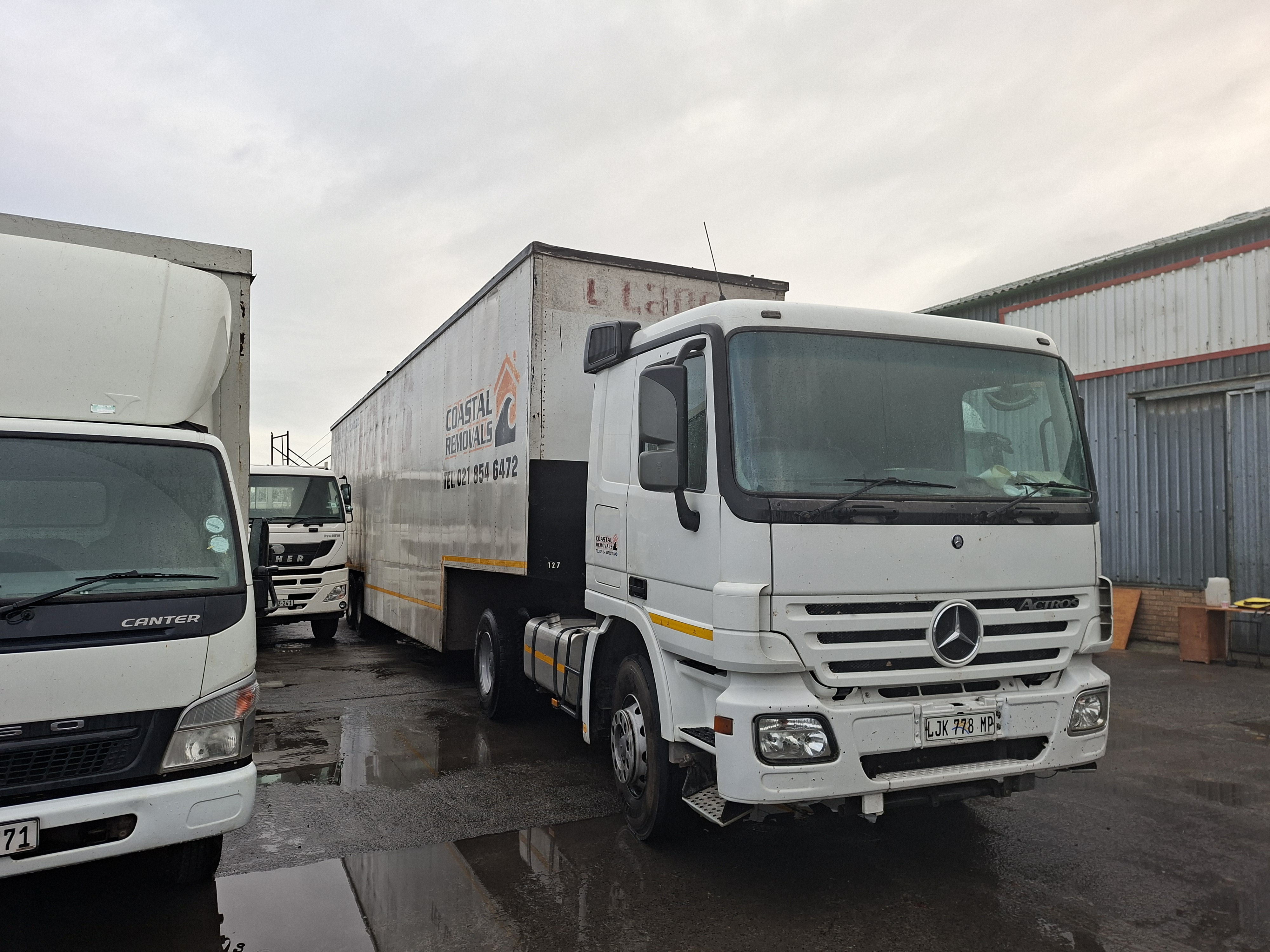
Container Truck Hire in South Africa, Eastern Cape — 20ft, 40ft & Superlink Container Haulage
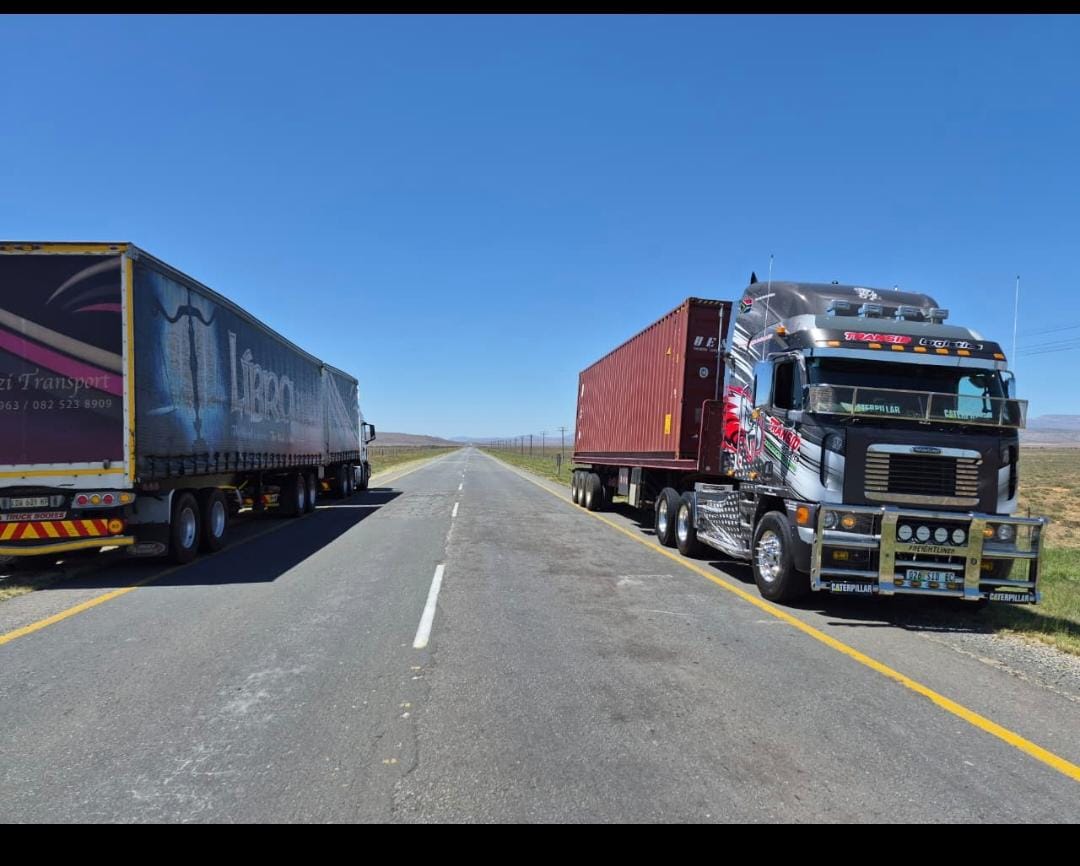
Verified transporter: container truck hire in South Africa, Eastern Cape, Reena. Available for port shuttles, port-to-inland, ICD, and cross-border container haulage.
Quick answer
A container truck is a truck-tractor towing a skeletal trailer or flatdeck link fitted with twist-locks that lock the shipping container to the trailer. In South Africa, Eastern Cape you can hire a container truck to move 6 m (20 ft) containers, 12 m (40 ft) containers, two 6 m containers on one trailer, or two 40 ft containers on a superlink. Prices start from R1,020.00 per day or R17.00 per km with a driver. Used for port-to-inland delivery, ICD shuttles, rail terminal transfers, and cross-border container haulage.
Why Container Trucks Are the Backbone of South African Import-Export Logistics
Every day, thousands of shipping containers move through South Africa's ports — Durban (the busiest container port in Africa), Cape Town, Port Elizabeth, Coega, and Richards Bay. Every one of those containers has to get from the port quay to an inland depot, a distribution centre, a factory, or a consignee's premises — and then the empty container has to get back. That vast two-way flow of loaded and empty containers is the backbone of the country's import-export economy, and the container truck is the vehicle that makes it work. From the quayside at Pier 1 in Durban to a warehouse in Gauteng, or from Ngqura to an assembly plant in the Eastern Cape, the container truck is the last mile — and usually the longest mile — of every container movement.
The container truck is not just a flatbed with different lashing points. It is a purpose-built vehicle whose entire design revolves around one component: the twist-lock. Every ISO shipping container has four corner castings — reinforced holes at each top and bottom corner. The trailer has four twist-locks — rotating cones that engage those castings and lock the container in place. That mechanical interface is what allows a 30-tonne steel box to travel safely at 80 km/h on the N3, corner without sliding, and be loaded and unloaded by cranes or reach-stackers at each end without special rigging. The twist-lock is the unsung hero of global trade, and every container truck we hire out is fitted with correctly matched twist-locks for the container being carried — 20 ft locks for 20 ft containers, 40 ft locks for 40 ft containers, or both for a trailer that carries either size.
At a Glance — Container Truck Specifications
| Container sizes | 6 m (20 ft) · 12 m (40 ft) · high-cube (HC) · two 6 m on one trailer · two 12 m on a superlink |
|---|---|
| Container types | Standard · High-Cube · Reefer (with genset) · Open-top · Flat-rack · Tank container · Side-door |
| Trailer configurations | Skeletal (bare chassis with twist-locks) · Flatdeck link (with container pins) · Superlink (two trailers in series) |
| Twist-locks | Four per container position — 20 ft, 40 ft, or adjustable (both) |
| Payload capacity | Up to 34,000 kg (including container tare weight) |
| Typical 40 ft container | Tare 3,800 kg · Max gross 30,480 kg · Cargo capacity 26,680 kg |
| Typical 20 ft container | Tare 2,200 kg · Max gross 24,000 kg · Cargo capacity 21,800 kg |
| Genset support | Available for reefer containers — clip-on diesel genset for road operation |
| Licence required | Code EC + PrDP for goods transport |
| Driver supplied | Yes — Code EC drivers with port, terminal, and ICD experience |
| Service area | South Africa, Eastern Cape, Reena, all major SA ports, ICDs, and cross-border |
Choose Your Container Truck Configuration
Container trucks come in several configurations, each suited to different container sizes, cargo types, and operating conditions. The right choice depends on the container size, the total weight, whether the container is loaded or empty, and the access and handling conditions at both ends. Here are the four container truck configurations most requested in South Africa, Eastern Cape.
6 m (20 ft) Container Truck Hire
20 ft containerOne or two per loadDistribution & factoryThe 6 m (20 ft) container truck carries a single 20 ft container on a short skeletal trailer, or two 20 ft containers on a longer trailer — usually on a flatdeck link with adjustable twist-locks. A 20 ft container has a tare weight of around 2,200 kg and a maximum gross weight of around 24,000 kg, giving a cargo capacity of approximately 21,800 kg. The 20 ft configuration is the standard for smaller consignments, factory-to-warehouse deliveries, and distribution-centre shuttle work where the container is packed and unpacked at the destination rather than loaded and unloaded as a full container.
Best for: smaller consignments, factory-to-warehouse deliveries, distribution-centre shuttles, single-container deliveries to premises without container handling equipment, and two-20-ft movements for paired consignments.
Typical industries: manufacturing, wholesale distribution, retail supply chain, food and beverage importers, and small-volume exporters.
Why customers choose it: the most flexible container configuration. A 20 ft container fits into tighter yards and premises access, and the option to carry two containers on one trailer gives a significant cost advantage on paired consignments.
12 m (40 ft) Container Truck Hire
40 ft containerStandard workhorsePort-to-inlandThe 12 m (40 ft) container truck is the standard workhorse of South African container haulage. It is a truck-tractor towing a skeletal trailer configured for a single 40 ft container — the most common container type for import and export freight. The trailer is fitted with 40 ft twist-locks at the correct positions to lock the container to the chassis. A 40 ft container has a tare weight of around 3,800 kg and a maximum gross weight of around 30,480 kg, giving a cargo capacity of approximately 26,680 kg. The 40 ft configuration is the default for port-to-inland haulage on the Durban-Gauteng corridor, the Cape Town-Gauteng corridor, and the Eastern Cape-Gauteng corridor.
Best for: port-to-inland container haulage, ICD transfers, rail terminal shuttles, full-container-load (FCL) import and export, and any standard container movement between ports, depots, and inland destinations.
Typical industries: shipping lines and freight forwarders, importers and exporters, third-party logistics operators, retail supply chain, and industrial importers.
Why customers choose it: the most common container size and the most common container truck configuration in South Africa. Every container terminal, ICD, and rail siding is designed around the 40 ft container, and the 34 ton container truck with a skeletal trailer is the standard vehicle for moving it.
Superlink Container Truck Hire
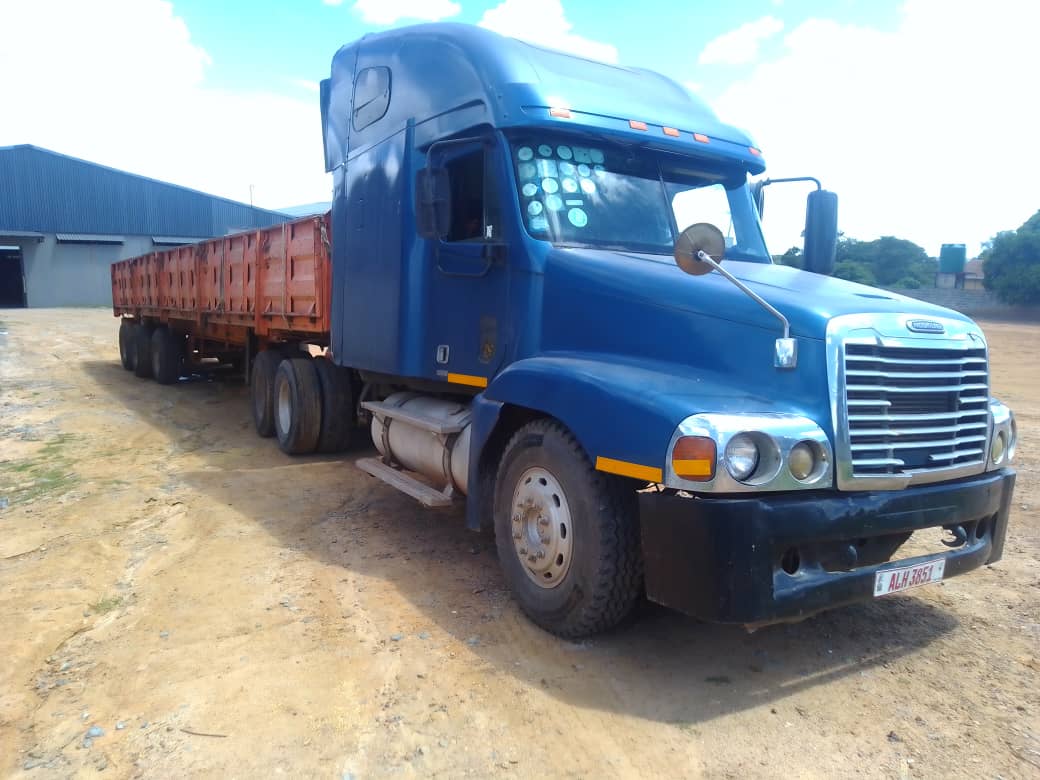
Two trailersTwo 40 ft containersMax volumeThe superlink container truck is a truck-tractor towing two skeletal trailers in series — usually a 12 to 13.5 m lead trailer and an 8 to 10 m pup trailer, connected by a converter dolly. It carries two 40 ft containers (or four 20 ft containers, or combinations) on a single tractor. The superlink is the highest-volume container configuration available on South African roads, and it is the standard for high-density import-export contracts where the volume justifies the two-trailer setup. It is used primarily on the Durban-Gauteng corridor and between ports and large inland depots where yard space and terminal infrastructure can accommodate the combination.
Best for: high-volume import-export contracts, port-to-inland container haulage at scale, and any container movement where the volume justifies a two-trailer combination.
Typical industries: major shipping lines, large freight forwarders, 3PL operators on the Durban-Gauteng corridor, and high-volume importers and exporters.
Why customers choose it: one tractor and one driver do the work of two single-trailer runs. Fuel cost per container-kilometre drops significantly, and the superlink is the standard configuration for large-volume container contracts.
Reefer Container Truck Hire
Reefer containerWith gensetCold chain import-exportThe reefer container truck carries a refrigerated shipping container — the same 20 ft or 40 ft dimensions as a standard container, but with an integrated refrigeration unit and insulated walls. The truck configuration is essentially the same as for a standard container: skeletal trailer, twist-locks, and correct chassis length. The additional requirement is power for the reefer unit. While on the terminal, the container runs off an external power supply. While on the road, the container runs off a clip-on diesel genset — a small generator that mounts to the container front and powers the reefer unit during transit. We supply the genset with the trailer where required. The reefer truck is the standard configuration for temperature-sensitive import and export cargo: pharmaceuticals, food, dairy, meat, seafood, and perishables.
Best for: temperature-sensitive imports and exports (pharmaceuticals, food, dairy, meat, seafood, perishables), port-to-inland reefer container movements, and any container that must hold a temperature set point while in transit.
Typical industries: pharmaceutical importers, food and beverage importers, meat and seafood exporters, fresh produce exporters, and cold chain 3PLs.
Why customers choose it: the reefer container itself does the cooling — the truck supplies the transport and the genset power. That means the cold chain is unbroken from the moment the container leaves the ship to the moment it arrives at the destination, even on a 30-hour Durban-to-Gauteng run.
Skeletal vs Flatdeck Link — Choosing the Right Container Trailer
| Feature | Skeletal Trailer | Flatdeck Link |
|---|---|---|
| Structure | Bare chassis with twist-locks | Flat platform with container pins or twist-locks |
| Tare weight | Lower — more payload for containers | Higher — slightly less container payload |
| Container compatibility | Excellent — purpose-built | Good — with correct pins |
| Other cargo | Containers only | Containers, steel, machinery, general freight |
| Best for | Dedicated container work, port shuttles | Mixed cargo, one-day containers next-day steel |
| Typical use | Shipping lines, container depots | Freight forwarders, multi-cargo operators |
Not sure which trailer suits your container job? Send us the container size, type, and weight on WhatsApp and we will recommend the correct configuration — free of charge.
South African Container Ports & Corridors
South Africa has five major container ports, and each serves a specific inland corridor. Here is a quick reference to the ports, their main corridors, and typical transit times from South Africa, Eastern Cape:
| Port | Main inland corridor | Typical transit time |
|---|---|---|
| Durban (Africa's busiest) | N3 to Gauteng via Pietermaritzburg, Harrismith, Warden, Villiers | 12 – 18 hours |
| Cape Town | N1 to Gauteng via Beaufort West, Kimberley, Bloemfontein | 24 – 30 hours |
| Port Elizabeth (Nelson Mandela Bay) | N10 and N2 to Gauteng via Cradock, Bloemfontein | 18 – 24 hours |
| Coega (Ngqura) | N10 to Gauteng and N2 to Cape Town | 18 – 24 hours |
| Richards Bay | N2 to Durban and N17 to Gauteng for bulk containers | 12 – 20 hours |
Long-distance container corridors from South Africa, Eastern Cape include runs to Durban, Cape Town, Port Elizabeth, Coega, Richards Bay, and inland ICDs at City Deep, Kaserne, and Isando. Cross-border container haulage runs into Botswana, Zimbabwe, Zambia, and Mozambique — typically from Durban and Richards Bay.
Container Truck Hire Prices in South Africa, Eastern Cape
Container truck hire pricing depends on the container size, the trailer configuration, the container weight, the distance, and whether the trip is a port shuttle, a port-to-inland run, or a cross-border movement. The two standard options below cover the vast majority of bookings.
Option 1 — Truck + Trailer Only
Self-drive, no driver
R 1,020.00 / Day
R 17.00 / km
Code EC licence + PrDP required. Fuel, tolls and driver excluded. Port access training required.
Enquire NowOption 2 — Truck + Driver
Full day with professional driver Best value
R 1,190.00 / Day
R 18.70 / km
Driver, insurance and GIT cover included. Port, terminal and ICD experienced.
Chat on WhatsAppWhat Affects the Cost of Container Truck Hire?
- Container size: a 40 ft container move costs more than a 20 ft move because of the trailer length and the total weight. Two-container moves (2×20 ft or superlink 2×40 ft) are priced per combination, not per container.
- Container weight: heavy containers (approaching 30,480 kg gross) require careful axle-loading verification but do not usually attract a premium — you are paying for the trailer and the distance, not the weight within legal limits.
- Trailer configuration: skeletal trailers are cheaper to hire than flatdeck links for container work, because they are lighter and purpose-built. Flatdeck links cost marginally more because they are more versatile.
- Distance: the per-kilometre rate drives your final price. Port shuttles are charged differently from long-distance port-to-inland runs and cross-border movements.
- Waiting time at the port or terminal: port entry, gate-in, container loading, and gate-out can take 2 to 6 hours depending on the terminal and the time of day. Waiting time beyond the agreed free period is charged hourly.
- Reefer genset: supplied with the trailer where required. Genset hire and fuel are quoted separately for reefer container movements.
- Container handling at destination: where the consignee does not have container handling equipment, we can arrange a crane truck or side-loader to offload the container at destination. Quoted separately.
- Cross-border documentation: COMESA Yellow Card, bilateral permits, TIP, transit bond, and customs clearance are quoted separately for cross-border container work.
- Duration and contract: weekly, monthly and long-term container contracts attract significant discounts over daily rates. Freight forwarders and 3PLs on the Durban-Gauteng corridor typically run monthly contracts.
Industries We Serve with Container Trucks in South Africa, Eastern Cape
- Shipping lines & freight forwarders: port shuttle, ICD transfers, and container repositioning on all major corridors.
- Importers & exporters: FCL (full-container-load) import and export deliveries between port, factory, and warehouse.
- Third-party logistics operators: container haulage on contract for shipping lines and freight forwarders on the Durban-Gauteng, Cape Town-Gauteng, and Eastern Cape-Gauteng corridors.
- Retail & FMCG: imported container deliveries to distribution centres and stores.
- Manufacturing: component and raw material imports, and finished goods exports.
- Pharmaceuticals & healthcare: reefer container movements for temperature-sensitive imports and exports.
- Food & beverage: reefer container movements for meat, dairy, seafood, and fresh produce export and import.
- Automotive: component imports and finished-vehicle component exports in containers.
- Chemical & industrial: bulk liquid tank container movements and packaged chemical imports.
- Cross-border traders: container haulage into Botswana, Zimbabwe, Zambia, and Mozambique from Durban and Richards Bay.
Container Types We Haul
Different container types have different trailer and twist-lock requirements. Here is a quick reference to the container types we routinely handle and any special configuration required:
| Container type | Trailer requirement | Notes |
|---|---|---|
| Standard 20 ft / 40 ft | Skeletal or flatdeck with correct twist-locks | The default — no special configuration required |
| High-Cube (HC) | Standard twist-locks | Taller than standard (2.9 m vs 2.6 m) — check bridge and route clearance |
| Reefer (refrigerated) | Standard twist-locks + genset clip-on | Requires genset for road operation, or a plug point where parked |
| Open-top | Standard twist-locks | Loaded by crane from above through a removable tarpaulin roof |
| Flat-rack | Standard twist-locks | No sides or roof — oversized or awkward cargo |
| Tank container (ISO tank) | Standard twist-locks | Bulk liquid transport — full documentation required |
| Side-door container | Standard twist-locks | Full-length side opening for forklift loading |
| Double-stack (uncommon in SA) | Specialist trailer | Rail and limited-road use — quoted per project |
How to Book a Container Truck in South Africa, Eastern Cape
- Tell us about the container. Enter the container size (20 ft or 40 ft), type (standard, high-cube, reefer, etc.), gross weight, pickup point, and drop-off point in the free estimate form on this page.
- Get an instant distance and fare. Our system calculates the road distance and your estimated fare immediately — no waiting for a callback.
- Choose your trailer configuration. Skeletal, flatdeck link, or superlink; single or double container; self-drive or with driver; genset for reefer containers.
- Confirm your booking. Submit the form or message us on WhatsApp. You will receive written confirmation with the trailer details, twist-lock configuration, driver details, and final price.
- Port or terminal arrangements. For port movements we confirm gate-in procedures, terminal access, and where required, container handling arrangements at the destination.
- Cross-border container trips: we will confirm permits, customs documentation, container sealing, and cross-border requirements before departure.
Why Choose WeTransport for Container Truck Hire
Verified & Fully Insured
Every container truck is licensed, roadworthy, and covered by comprehensive insurance plus goods-in-transit cover for the container and its cargo.
Correct Twist-Lock Configuration
Every trailer is fitted with the correct twist-locks for the container being carried — 20 ft, 40 ft, or adjustable. Twist-locks checked before every departure.
Port, Terminal & ICD Experienced Drivers
Drivers who know the gate procedures, terminal systems, and container weight verification requirements at every major South African port.
Reefer Genset Supplied
Clip-on diesel gensets supplied with the trailer where required, so reefer containers hold temperature through the entire road journey.
Cross-Border Container Ready
COMESA Yellow Card, bilateral permits, TIP, transit bond, and customs documentation arranged for cross-border container movements.
Transparent Pricing
Clear per-day and per-kilometre rates quoted up front. No hidden call-out fees or surprise surcharges on container contracts.
Container Truck Hire in Reena and Nearby Areas
We arrange container truck hire throughout South Africa, Eastern Cape and the greater Reena region, including port shuttles, port-to-inland container haulage, ICD transfers, rail terminal shuttles, and cross-border container movements. Popular container truck routes from South Africa, Eastern Cape include runs to Durban (N3), Cape Town (N1), Port Elizabeth and Coega (N10), Richards Bay (N2 and N17), and cross-border to Gaborone, Harare, Lusaka, and Maputo.
Insurance, Tracking & Compliance
- Insurance: Yes Active
- Live tracking: Live GPS tracking available
- Goods in transit: Yes Active
- Driver compliance: valid Code EC licence, valid PrDP for goods transport, medical fitness certificate, and port access clearance where required
- Vehicle compliance: current licence disc, roadworthy certificate, operator card, calibrated tachograph where required, and current twist-lock inspection certificate
- Container compliance: twist-locks matched to container size and type; container seals verified and recorded where required
- Overload compliance: container gross weight verified against trailer plate and GCM limits before departure; weighbridge certificates available on request
- Reefer compliance: genset supplied and fuelled where required; temperature set point confirmed at loading and monitored in transit
- Cross-border compliance: COMESA Yellow Card, bilateral permits, TIP, transit bond, and country-specific GIT confirmation arranged per corridor